
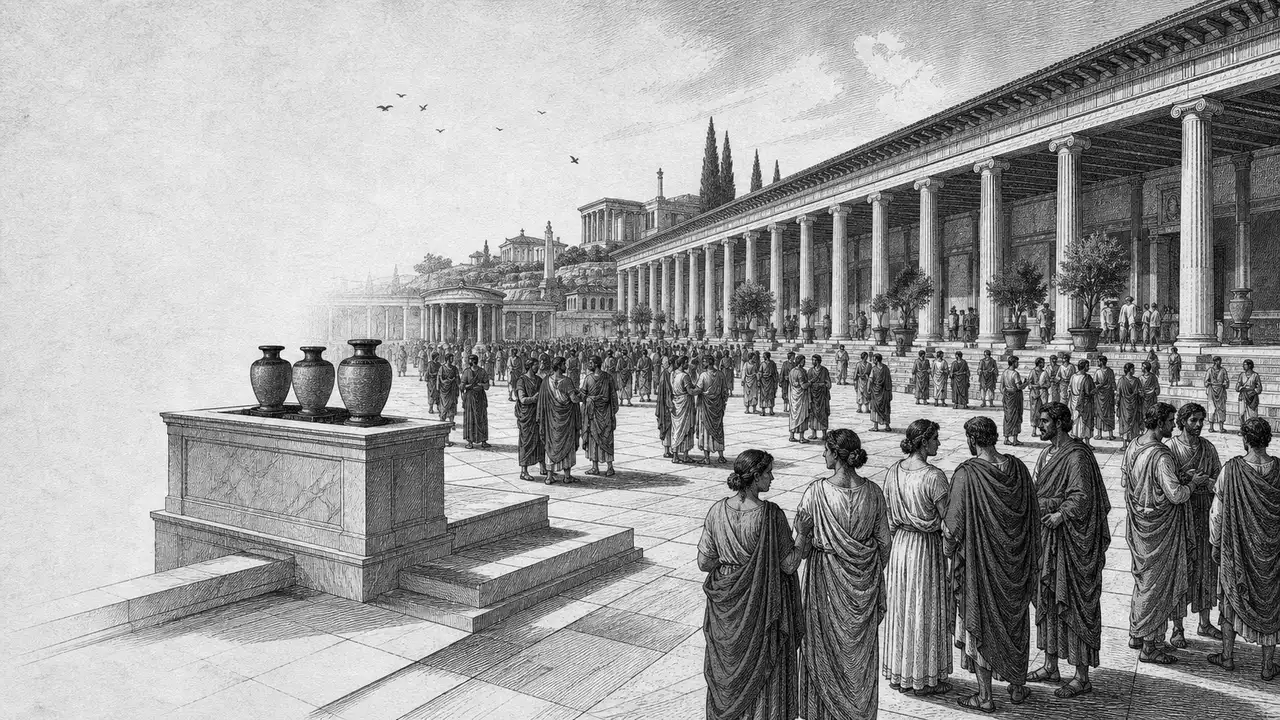
Politeia

The Charter of Valoria.

Twelve articles set the terms between the people, the Party, and every office the state creates.

The Charter of Valoria

Political direction, expert knowledge, public participation, planning, and constitutional review share one order; no part governs alone. Adopted by the Constitutional Council in its first session. Articles may be amended by the people’s congresses alone. Nothing in this charter is held by any generation.

  1. The community owns what everyone depends on.

    Land, water, energy, and the great means of production rest in common hands, because ownership of what all life requires is power over all lives.

    Mechanism: Four ownership tiers hold the economy, and no tier may be bought out of the commons; removing a classification requires a heightened constitutional process.

  2. The plan sets direction. Capital holds no veto.

    Foreign capital may contribute to national development. It may never gain a veto over it.

    Mechanism: The national plan binds investment licensing, and the congress debates it, funds it, and audits it.

  3. Politics answers one test: does it leave people better able to live their lives.

    Every office stands to that test: leaders, experts, courts, this charter. One thing is permanent: the Party and its leading role. Everything else stands for review.

    Mechanism: Rotation, audit, recall, and published review; no leadership generation is permanent.

  4. Four pillars carry the state, and none outranks the others.

    Human Development, Civilizational Advancement, Harmonized Continuity, and Liberation and Reconstruction are the coequal foundations. Each carries a protected minimum below which society may not fall.

    Mechanism: Conflicts above the minimums are resolved by evidence, legal review, and public explanation, never by silencing a pillar.

  5. Three thousand six hundred delegates carry the National Congress, and most come from the ranks by lot.

    Sixty percent are Party members selected at random; the rest are experts, workers, youth, regions, and civic bodies. No seat is for sale, and none is hereditary.

    Mechanism: The Congress legislates, budgets, and oversees; its committees can compel testimony, demand documents, and force corrective plans from any ministry.

  6. Experts hold the pen on evidence, never the last word on power.

    The Council of Experts reviews, stress-tests, and challenges every major plan. Its authority is serious, and it is not the government.

    Mechanism: About fifty to seventy members serve staggered terms, reviewed on performance and ethics; expertise must not become a self-protecting caste.

  7. The plan is a public commitment with dates attached.

    Five-Year Plans state what the country will build, what its institutions owe, and what happens when reality differs from the design.

    Mechanism: Targets are readable, variances are published, and every major strategy faces an independent counter-plan.

  8. Rights are guarantees, not rewards.

    Rights to person, due process, material security, education, healthcare, participation, and lawful criticism cannot be removed because a person is unproductive, unpopular, or unconventional.

    Mechanism: Some protections never suspend: dignity, freedom from torture, court access, food, shelter, and medical care hold even in emergency.

  9. Emergency powers are borrowed, never owned.

    A state of emergency is declared with its scope and duration stated, and it expires unless lawfully renewed.

    Mechanism: Sixty days for disaster, ninety for war, thirty for internal security; automatic review within fourteen days, and a fresh vote for every renewal.

  10. The constitution binds every institution, including the Party.

    No office stands above it. Constitutional review and an independent procuracy hold state and Party alike to the text.

    Mechanism: Any institution’s act can be tested against the constitution, and emergency action receives automatic review.

  11. Every leadership generation is temporary.

    Removal begins with a third of the Central Committee, the Political Bureau, the Constitutional Council, or the Procuracy, and ends in secret ballots.

    Mechanism: A vacant office is refilled within sixty days; until then the standing committee acts collectively, and it may not rewrite the plan or amend the constitution.

  12. Amendment is deliberate, not impossible.

    Ordinary amendment needs three-quarters of the National Congress and two-thirds of the Party Congress. The foundations need more: eighty-five percent and three-quarters.

    Mechanism: The pillars, Party leadership, the socialist character, planning, and the congress’s structure are protected foundations: safe from ordinary majorities, never from the people’s congresses.

A first-pass constitutional canon: the skeleton stands, and article drafting continues.

Go deeper

Longer reading and the adjacent systems this one leans on.

  1. Longer readingAn Earlier Charter DraftAn earlier long-form charter draft, retained as historical reading rather than a statement of the active first-pass constitutional canon.